
Section 01
Why the Break Is a Required Part of the Technique — Not a Reward
Many people treat Pomodoro breaks as optional rewards for finishing a session. Cirillo's own framing is different: in his design, one Pomodoro is not 25 minutes of work — it is 25 minutes of work plus the break that follows. The two are inseparable. Skipping or shortening the break undermines the entire system.
According to the Emory University Libraries' documented version of the core Cirillo process, the break 'gives you the time you need to disconnect from your work. This allows your mind to assimilate what's been learned in the last 25 minutes and also gives you a chance to do something good for your health.' The explicit instruction is: 'Do not engage in anything that requires significant mental effort.'
This matters because what you do during the break determines whether it actually restores you. A 2022 systematic review and meta-analysis published in PLOS ONE, covering 22 independent study samples and over 2,300 participants, found that microbreaks significantly boost vigor and reduce fatigue — but that passive breaks, where someone simply stops working without any deliberate activity, are less effective than breaks where a specific restorative activity is chosen.
- Cirillo defines one Pomodoro as 25 minutes of work + the break — not work alone
- The purpose of the break is cognitive disconnection and physical recovery
- The activity matters: passive stopping restores less than deliberate recovery activities
- Cirillo's rule: do not begin anything requiring significant mental effort during the break
Section 02
What to Do During a 5-Minute Short Break
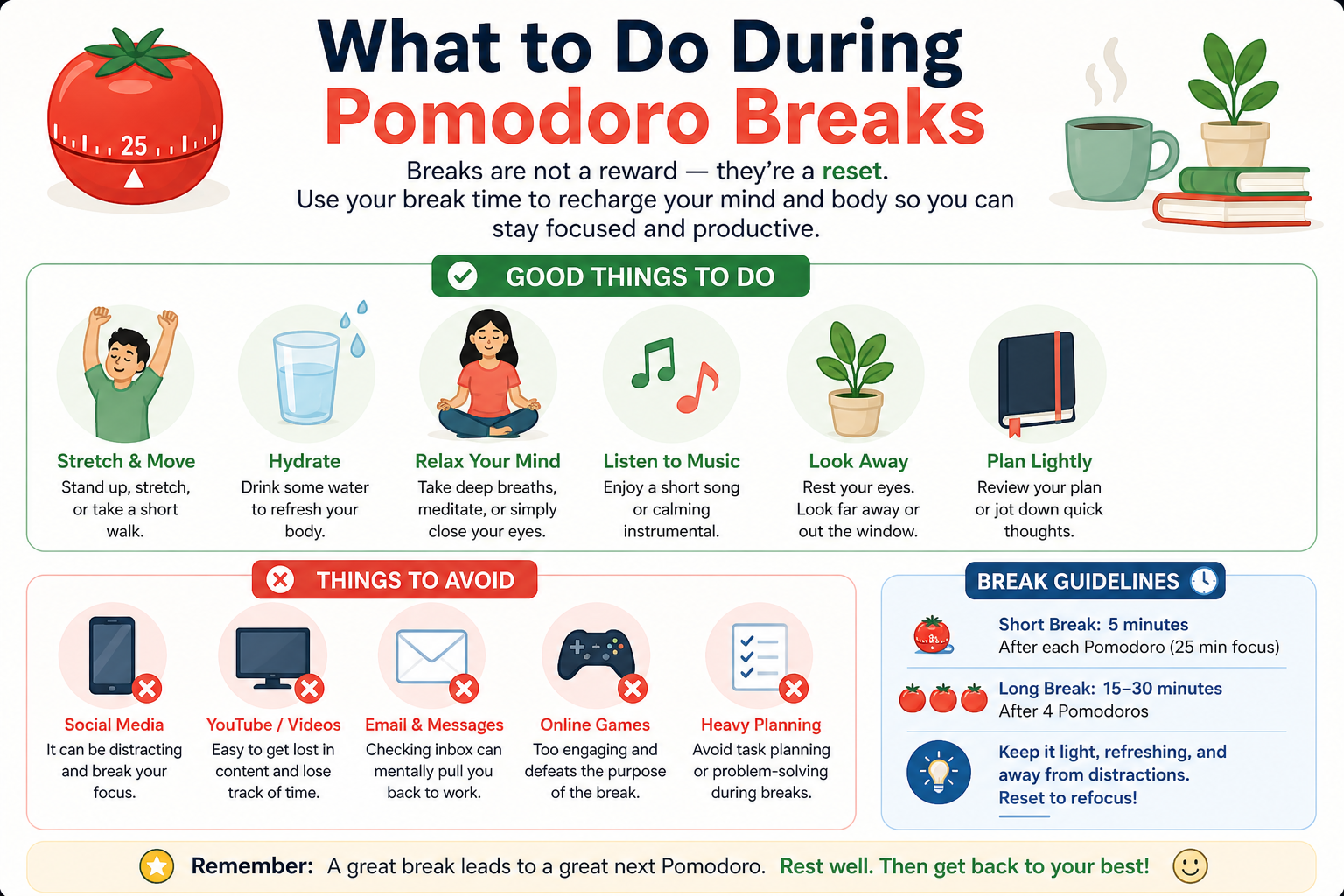
Five minutes is short, so the goal is not to start something — it is to genuinely step away from the task. The best short-break activities share one property: they contrast with sitting at a screen doing cognitive work. If your work is visual and mental, your break should be physical and screen-free.
Stand up and move. Walking around your room, doing a few stretches, or going to refill your water are among the most consistently supported short-break activities in the microbreak research literature. A study on movement microbreaks published in Frontiers in Public Health found that interrupting sedentary work with brief movement led to meaningful reductions in job-related stress over a three-month period. Even light movement — standing, walking to another room — counts.
Rest your eyes. If your work involves a screen, your eyes have been holding a close focal point for 25 minutes. Looking at a distant object or stepping near a window to look outside allows the focusing muscles in your eyes to relax. This is the principle behind the widely cited 20-20-20 guideline (look at something 20 feet away for 20 seconds every 20 minutes), which eye care practitioners recommend as a way to interrupt continuous near-work, though the specific numbers have limited peer-reviewed support compared to the broader principle of taking screen breaks.
Drink water or have a small snack. Hydration and light nutrition support sustained attention. Getting up to refill a glass of water also forces you to stand and move, which combines two restorative behaviors in one action.
Breathe deliberately. If you cannot leave your workspace, a few minutes of slow, deliberate breathing is a low-effort recovery option. Breathing exercises such as the 4-7-8 pattern (inhale for 4 seconds, hold for 7, exhale for 8) have been cited as a way to reduce physiological stress during the workday.
- Stand up and walk — even to the kitchen or bathroom counts
- Look out a window or at a distant object to rest your eye muscles
- Refill your water glass — hydration and movement in one action
- Do a few shoulder rolls or neck stretches if your workspace is small
- Breathe slowly and deliberately — 4-7-8 breathing is a common option
- Step outside briefly if possible — even 60 seconds of natural light helps
Section 03
What Not to Do on Your Short Break
The most important guidance in this section comes directly from Cirillo: the break must be disconnected from work. No emails. No Slack. No project-related reading. These activities keep your cognitive resources engaged on the same kind of processing you just spent 25 minutes doing, which means your brain does not actually recover.
Social media scrolling is one of the most common break habits and one of the least restorative. Research on microbreak activity types consistently shows that activities requiring sustained attention or information processing provide less recovery than movement or relaxation. Scrolling a social feed involves continuous processing of new stimuli — it replaces one form of cognitive load with another. Writer Dean Kissick described the shift in a reflection cited by Todoist: when his breaks became deliberately limited, he found himself choosing more restorative activities rather than 'the unimaginative temptations I would otherwise default to — flopping on the sofa, scrolling on my phone.'
Similarly, checking your personal messages, reading the news, or watching a video — while technically not 'work' — all keep your visual and cognitive systems engaged. For a 5-minute break to do its job, the aim is to give your attention a genuine rest, not redirect it.
- Do not check email or Slack — these extend your cognitive workload
- Do not scroll social media — it replaces one attention demand with another
- Do not watch videos — sustained screen attention is not rest for your brain or eyes
- Do not start a new task — the break is not for multitasking
- Do not sit in the same position — physical stillness compounds mental fatigue
Section 04
What to Do During a Long Break (15–30 Minutes After Four Pomodoros)
After completing four consecutive Pomodoros, Cirillo prescribes a longer break of 15 to 30 minutes. The purpose is the same as a short break but deeper: the brain needs more time to consolidate what it has processed and to restore the resources needed for the next block of four.
Cirillo himself lists the following as appropriate long-break activities in his documented technique: tidying your workspace, getting a coffee, listening to voicemails, resting, doing breathing exercises, or taking a walk. The common thread is that none of these require complex thinking. 'The important thing is not to do anything complex; otherwise your mind won't be able to reorganize and integrate what you've learned,' according to the documented core process.
A genuine walk outdoors — even a short one — is one of the most effective long-break options supported by the general break research. Moving your body, changing your environment, and getting natural light all contribute to cognitive recovery. For students, a 2023 study published in the British Journal of Educational Psychology found that taking predetermined systematic breaks during a study session produced mood benefits and appeared to have efficiency benefits compared to self-regulated breaks. A proper long break helps set up the next block of Pomodoros to go more smoothly.
Light household tasks also work well for long breaks. Doing the dishes, unloading the dishwasher, putting on laundry, or tidying a surface keeps your body moving while requiring almost no focused attention. These tasks feel productive without competing with the cognitive work you will return to.
- Take a walk outside — 10–15 minutes of movement and natural light is highly restorative
- Prepare a meal or snack — light cooking requires hands but not focused attention
- Do light chores — dishes, laundry, tidying; physical and mentally low-demand
- Have a proper coffee or tea — away from your desk, not at it
- Call or message a friend briefly — social connection is restorative for many people
- Rest your eyes completely — lie down or look out a window with no screen
- Light stretching or a short yoga sequence — works well if you cannot go outside
Section 05
The Right Break Is Partly Personal
Research on break-taking consistently notes that effectiveness varies between individuals. A 2025 study published in the journal Behavioral Sciences, which investigated Pomodoro, Flowtime, and self-regulated breaks among 94 university students, found that 'break effectiveness depends highly on the nature of activities and experiences during the break' and that individual factors — including personality traits such as emotional stability and extraversion — influenced how much recovery a given break provided.
This means the suggestions in this guide are starting points, not rigid rules. Some people find that a few minutes of meditation or deep breathing restores them more than movement. Others find that a short walk outside is the only break that genuinely resets their focus. It is worth experimenting with different break activities during your first two to three weeks of using the Pomodoro Technique to find what works for your work context and your personality.
What the research does consistently support is the contrast principle: whatever you do during the break should contrast with what you were doing during the session. If your work is sedentary, cognitive, and screen-based — which describes most desk work and studying — then effective breaks tend to be physical, low-stimulation, and screen-free.
- Break effectiveness varies by person — experiment to find what works for you
- Emotional stability and personality traits influence how much a given break restores you
- The contrast principle is consistent: your break activity should contrast with your work
- Desk workers benefit most from physical, screen-free breaks
- Track how you feel at the start of each new Pomodoro to calibrate which breaks help most
Section 06
Quick Reference: Short Break vs. Long Break
The Pomodoro Technique uses two types of breaks. Short breaks (5 minutes) follow each individual Pomodoro. Long breaks (15–30 minutes) follow every fourth Pomodoro. The activities suited to each differ in scope, not in principle.
For short breaks, the priority is physical movement and eye rest. You do not have enough time to start something complex, and the goal is simple disconnection. For long breaks, you have enough time to genuinely recharge — a walk, a meal, or a set of light chores gives your brain the recovery it needs before the next four-Pomodoro block begins.
- Short break (5 min): stand up, walk, stretch, drink water, look at a distance
- Short break: avoid screens, email, social media, and any mentally demanding activity
- Long break (15–30 min): walk outside, prepare food, light chores, proper rest
- Long break: still avoid complex cognitive work — the brain needs genuine downtime
- Both break types: completely disconnected from the task you were working on
FAQ
Common questions
What should I do during a 5-minute Pomodoro break?
Stand up, move around, drink water, and rest your eyes by looking away from the screen. The goal is physical and cognitive contrast with your work session. Avoid screens, social media, and email — these keep your cognitive load high and prevent genuine recovery.
Can I check my phone during a Pomodoro break?
Cirillo's original guidance says the break must be fully disconnected from work and should not involve anything requiring significant mental effort. Scrolling social media or reading messages keeps your attention engaged, which reduces how much the break restores you. It is better to stand up, move, and stay off the screen during your 5 minutes.
Is it okay to do nothing during a Pomodoro break?
Simply stopping work without a deliberate activity is less effective than choosing a restorative behavior. A 2022 meta-analysis in PLOS ONE found that passive breaks restore less vigor than breaks involving a specific activity such as movement or relaxation. Doing something — even just walking to another room — is better than sitting still at your desk.
What should I do during a long Pomodoro break (15–30 minutes)?
Cirillo recommends activities that are physically active but cognitively light — tidying your workspace, going for a walk, making a coffee, or listening to something relaxing. The key rule is the same as for short breaks: do not start anything complex. Your brain needs this time to consolidate what it has processed before your next block of four Pomodoros.
Why does my Pomodoro break not feel refreshing?
The most common reason is that the break activity keeps your cognitive load high. If you spend your break checking email, scrolling social media, or worrying about the next task, your brain does not actually recover. Try switching to a screen-free, physically active break — walk around, stretch, or make a drink — and you should notice a difference in how ready you feel when the next Pomodoro starts.
Can I exercise during a Pomodoro long break?
Light exercise — stretching, a short walk, bodyweight movements like squats or pushups — is one of the best long-break activities. Research on movement microbreaks consistently shows benefits for mood, fatigue, and sustained focus. Avoid intense workouts that leave you physically depleted before returning to cognitive work.
Should I use my Pomodoro break to plan the next session?
Brief planning — glancing at your task list to know what comes next — is acceptable and takes only a moment. But Cirillo's guidance is clear that the break should not involve significant mental effort. Extended planning, rewriting your task list, or rethinking your priorities should wait until the break is over or be saved for the longer break after four Pomodoros.