
Section 01
What Is the Pomodoro Technique?
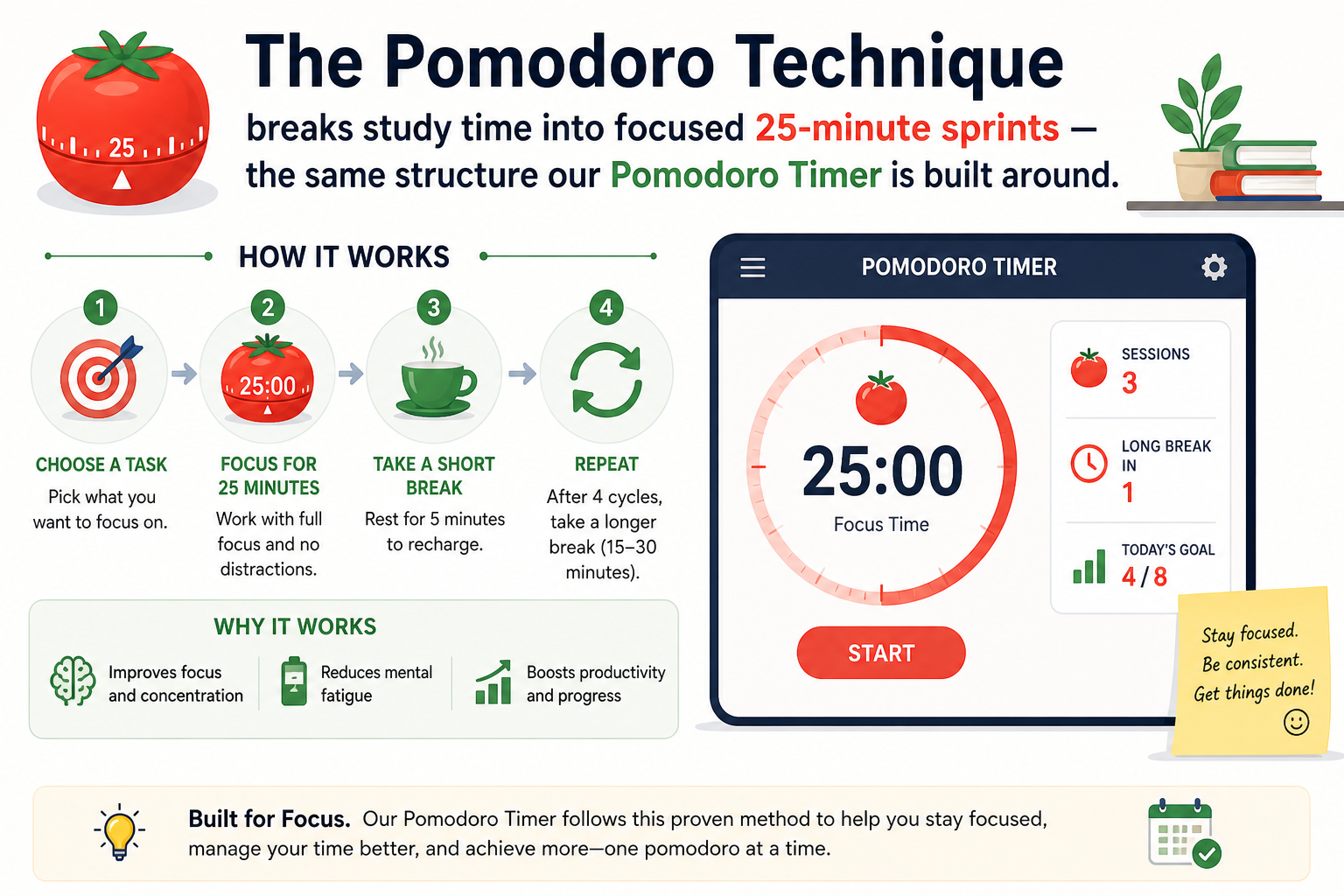
The Pomodoro Technique is a time management method developed by Francesco Cirillo in the late 1980s. It uses a timer to break work into intervals — typically 25 minutes of focused effort — separated by short breaks. Each 25-minute work interval is called a 'pomodoro' (Italian for tomato), named after the tomato-shaped kitchen timer Cirillo used when he created the method as a university student struggling to focus on his studies.
The structure is simple: set a timer for 25 minutes and work on one task without interruption. When the timer rings, take a 5-minute break. After completing four pomodoros, take a longer break of 15 to 30 minutes. That full cycle — four focused sessions with short breaks and one long break — is the core rhythm of the technique.
A key rule of the original method is that a pomodoro is indivisible. If you are interrupted mid-session, you either defer the interruption or abandon that pomodoro and restart. The physical act of setting a timer — whether a kitchen timer or our Pomodoro Timer — signals to your brain that a period of focused work is beginning. Cirillo himself wrote a 130-page book formalising the technique, which has since been translated into over 15 languages and used by millions of students and professionals worldwide.
- 1 Pomodoro = 25 minutes of focused work on a single task
- Short break = 5 minutes after each pomodoro
- Long break = 15–30 minutes after every four pomodoros
- A pomodoro is indivisible — interruptions are noted and deferred, not acted on
- Any timer works — our Pomodoro Timer is built around this exact rhythm
Section 02
Why the Pomodoro Technique Works for Students
The technique is not just popular anecdote — there is genuine cognitive science behind why it works. Research on attention suggests that the brain can maintain optimal focus for approximately 20 to 45 minutes before performance begins to decline. The 25-minute pomodoro interval aligns directly with this natural attention window, preventing cognitive overload while keeping the mind engaged.
A 2011 study published in the journal Cognition by Atsunori Ariga and Alejandro Lleras at the University of Illinois demonstrated that even brief mental breaks significantly improve sustained attention over long periods. The researchers found that the brain exhibits a natural vigilance decrement — a gradual erosion of focus quality during uninterrupted effort — and that short breaks reset this decline before it compounds. The goal of the Pomodoro Technique's mandatory breaks is not to interrupt flow but to schedule recovery before fatigue accumulates.
The technique also directly targets procrastination — the most common study problem students face. Psychologist Piers Steel's landmark 2007 meta-analysis in Psychological Bulletin found that task aversiveness is a key driver of delay. 'Study for my exam' is a large, aversive task. 'Do one 25-minute pomodoro of biology revision' is manageable. Breaking work into 25-minute chunks dramatically reduces the perceived difficulty of starting — and starting is the hardest part.
A 2025 meta-analysis of Pomodoro interventions, published in a peer-reviewed journal, found that time-structured Pomodoro sessions consistently improved focus, reduced mental fatigue, and enhanced sustained task performance compared with self-paced studying. A separate study with 25 Pomodoro users and 35 control students found that while control students chose longer study sessions, those longer sessions were associated with higher fatigue and lower concentration and motivation.
- Brain optimal focus window: approximately 20–45 minutes before performance declines
- 2011 Cognition study: brief breaks significantly improve sustained attention over long sessions
- 2025 meta-analysis: Pomodoro outperformed self-paced breaks for focus, fatigue, and task performance
- Procrastination research: breaking tasks into 25-minute chunks reduces perceived aversiveness
- Study with students: longer unstructured sessions led to higher fatigue and lower motivation than Pomodoro sessions
- Switching tasks reduces productivity by up to 40% — one task per pomodoro prevents this
Section 03
How to Use the Pomodoro Technique for Studying — Step by Step
Getting started with the Pomodoro Technique takes less than two minutes. Here is the full process from setup to completion of your first session.
Step 1 — Choose one specific task: Avoid vague goals like 'study biology.' Instead, define a concrete objective for each session: 'review Chapter 4 notes,' 'complete problem set 3,' or 'write the introduction paragraph.' The more specific the task, the easier it is to stay on it for 25 minutes.
Step 2 — Open our Pomodoro Timer and start the 25-minute countdown: Remove distractions before the timer starts. Put your phone face-down, close unnecessary browser tabs, and mute notifications. Commit to focusing only on your chosen task until the timer rings.
Step 3 — Work on the task until the timer rings: If a stray thought, another task, or a distraction crosses your mind during the session, write it down on a notepad and return immediately to your task. Writing it down closes the mental loop without acting on it. A pomodoro cannot be paused — if an unavoidable interruption occurs, void the session and restart.
Step 4 — Take a 5-minute break when the timer rings: Stop working even if you feel you could continue. Stand up, walk around, drink water, or look out a window. Do not check social media — a 5-minute scroll can easily become 30. The break is for recovery, not stimulation.
Step 5 — After four pomodoros, take a 15–30 minute long break: This longer rest allows your brain to consolidate what you have studied and recover fully before the next cycle. Use it for a meal, a walk, or genuine rest away from your desk.
- Step 1: Choose one specific, concrete task — not a vague subject
- Step 2: Open the Pomodoro Timer, eliminate distractions, start the 25-minute countdown
- Step 3: Work on the single task — write down distractions instead of acting on them
- Step 4: When the timer rings, take a 5-minute break — stand, walk, drink water
- Step 5: After 4 pomodoros, take a 15–30 minute long break
- Track your completed pomodoros — it builds momentum and shows you how much you have done
Section 04
What to Actually Do During Your Pomodoro Breaks
The break is half the technique — and it is the half most students get wrong. The purpose of a Pomodoro break is genuine mental recovery, not a different kind of stimulation. According to the Emory University Library guide on the Pomodoro Technique (drawing on Cirillo's original method), the 5-minute break gives your mind time to assimilate what it has just processed and recover before the next session. You should not engage in anything that requires significant mental effort during a short break.
The worst thing you can do during a break is open social media. Spending your 5-minute break scrolling through Instagram or TikTok is a common mistake that can easily turn into 20 or 30 minutes of missed time and leaves your brain more stimulated than when you started. Social media is designed to hold your attention — the exact opposite of what a recovery break needs.
Good break activities include: standing up and walking around, drinking a glass of water, looking out a window or at something far away to rest your eyes, light stretching, or simply sitting quietly. On your longer 15–30 minute breaks, Birmingham City University's revision guide recommends getting outdoors or eating a meal away from your desk and study materials. The goal is to return to your next pomodoro feeling genuinely refreshed — not just distracted.
- Good short break activities: walking, water, stretching, looking out a window, sitting quietly
- Good long break activities: going outside, eating a meal, light exercise, a short nap
- Avoid during breaks: social media, video content, emails, new complex tasks
- Scrolling social media during a 5-minute break can easily stretch to 20–30 minutes
- The break's purpose is brain recovery — not entertainment or further stimulation
Section 05
Using the Pomodoro Technique During Exam Season
Exam season is where the Pomodoro Technique proves most valuable — and where most students make the biggest study mistakes. Long, unstructured hours at a desk often lead to fatigue and poor retention, not because the student lacks effort but because the brain cannot sustain quality focus for hours without structure.
The most effective approach during exam prep is to plan your pomodoros before you start. Each morning, list the specific tasks you need to accomplish across each subject and estimate how many 25-minute sessions each will require. For a light study day, 8 to 10 pomodoros (around 4 to 5 hours of actual focused study) is a reasonable target. For intensive exam preparation, 12 to 16 pomodoros spread across the day — equating to 6 to 8 hours of genuine study — is a realistic upper limit. Quality always outweighs quantity: 10 focused pomodoros will consistently outperform 14 distracted ones.
Assign each pomodoro to a single subject or task type. Avoid switching between subjects mid-session. If you have multiple exams approaching, dedicate blocks of pomodoros to each subject rather than attempting to cover everything in a single session. The Oregon State University Academic Success Center recommends treating each pomodoro like a sprint: lean into the intensity of the short burst rather than pacing yourself across a longer undefined period.
- Plan your pomodoros before you start — list specific tasks, not vague subjects
- Light study day target: 8–10 pomodoros (~4–5 hours of focused study)
- Intensive exam prep target: 12–16 pomodoros spread across the day (~6–8 hours)
- Assign each pomodoro to one subject or task only — no switching mid-session
- Each pomodoro is a sprint: lean into the intensity rather than trying to maintain a slower, longer pace
- Combine Pomodoro with active recall and spaced repetition for strongest exam retention
Section 06
Adapting Pomodoro to Different Study Tasks
The 25/5 rhythm is a starting point, not a fixed rule. Different types of study tasks benefit from different approaches, and the Pomodoro Technique is explicitly designed to be adapted.
Maths and problem sets: Stick to the standard 25 minutes. Problem-solving is cognitively demanding and focus declines quickly. Use each pomodoro for a specific set of problems. If you finish early, review your working or attempt a harder variation — do not move to a new topic until the timer rings.
Essay writing and assignments: A 50/10 structure (50 minutes of work, 10-minute break) often works better for writing, where getting into a deeper flow state is part of the process. Break the essay into clear pomodoro-sized tasks: one session for outlining, one for researching, one for drafting each section, one for editing. Dividing your essay into sections and completing them pomodoro by pomodoro is a well-established approach for managing long writing tasks.
Reading and note-taking: Standard 25 minutes works well. Use active recall during the break — close your notes and write down everything you remember from what you just read. This reinforces retention far more than re-reading.
Languages and vocabulary: Alternate task types across pomodoros. One session for grammar, one for vocabulary flashcards, one for listening or reading practice. Variety within the subject keeps engagement higher across a long study block.
- Maths / problem sets: standard 25/5 — focus on a specific problem set per session
- Essays and writing: try 50/10 intervals — outline, research, draft, and edit as separate pomodoros
- Reading / note-taking: standard 25/5 — use active recall during breaks to reinforce retention
- Languages: alternate task types (grammar, vocabulary, practice) across consecutive pomodoros
- If you finish a task before the timer rings: review your work, improve it, or reinforce it — do not switch tasks early
- Large tasks requiring more than 4 pomodoros should be broken into specific subtasks first
Section 07
Customising Your Pomodoro Intervals
The standard 25/5 structure is where everyone starts — but it is not the only valid interval. The technique's creator Francesco Cirillo himself acknowledged that timing should reflect individual needs, and research supports the idea that optimal focus intervals vary by person, task, and time of day.
For beginners or students with ADHD: starting with shorter intervals — 15 or 20 minutes of work with a 5-minute break — is completely valid. Birmingham City University's revision guide notes that the Pomodoro method is particularly useful for students with ADHD because it provides short, structured study sessions without requiring focus for too long. The goal at first is building the habit of structured study, not achieving maximum output.
For deep work tasks like essays or complex problem-solving: some students and researchers find that longer blocks work better once focus is established. Longer blocks of 30 to 60 minutes can be effective for tasks requiring a deeper flow state, though Oregon State University's Academic Success Center advises against blocks of 60 to 90 minutes without a break, as the risk of fatigue and distraction increases significantly.
A practical approach suggested by experienced Pomodoro users is to use longer blocks early in the day when your brain is fresh and shorter blocks toward the end of the day as your ability to concentrate begins to decrease. Our Pomodoro Timer lets you set custom intervals so you can adjust both work and break duration to whatever rhythm suits your current study needs.
- Beginners or ADHD students: start with 15–20 minute work intervals and build up gradually
- Standard: 25 minutes work / 5 minutes break — the most widely used and researched structure
- Deep work / writing: 50 minutes work / 10 minutes break — better for tasks requiring sustained flow
- Early in the day: use longer blocks when focus is naturally stronger
- Later in the day: shorten blocks as concentration begins to wane
- Our Pomodoro Timer supports custom intervals — adjust work and break durations to fit your session
Section 08
5 Common Pomodoro Mistakes Students Make
The Pomodoro Technique is simple, but there are several ways students apply it ineffectively. Knowing the mistakes in advance saves you from learning them the hard way.
Mistake 1 — Skipping breaks: It feels productive to push through when you are on a roll, but skipping breaks accelerates the fatigue that makes the next hour of study less effective. The break is not a reward — it is a required part of the method. Students who skip short breaks consistently report higher fatigue across the study session.
Mistake 2 — Using your phone during breaks: Spending your 5 minutes scrolling social media is one of the most common and costly mistakes. It does not rest your brain — it stimulates it differently, and it makes returning to focused work harder. Keep your phone face-down during both work sessions and short breaks.
Mistake 3 — Multitasking within a pomodoro: A pomodoro must be dedicated to one task only. Checking emails, replying to messages, or switching between subjects during a session fragments your attention. Research from the American Psychological Association found that task-switching reduces productivity by up to 40 per cent.
Mistake 4 — Being too rigid with the 25-minute interval: If you are in a genuine flow state and the 25-minute mark feels disruptive, it is acceptable to extend the session. The purpose of the interval is to sustain focus, not interrupt it. Experiment with what works for you and your current task.
Mistake 5 — Passive tasks during sessions: Pomodoros work best with active learning — solving problems, writing, summarising, self-testing. Passive re-reading of notes while distracted is still passive re-reading regardless of the timer. Assign each pomodoro to something that requires active mental engagement.
- Mistake 1: Skipping breaks — breaks are part of the method, not optional
- Mistake 2: Scrolling social media during breaks — this stimulates rather than restores
- Mistake 3: Multitasking within a session — one task per pomodoro, no exceptions
- Mistake 4: Being too strict about 25 minutes — if you are in flow, it is fine to extend
- Mistake 5: Passive tasks — pomodoros work best with active, effortful learning
Section 09
Start Your First Pomodoro Session Right Now
The best time to start is now — not after you finish planning, not after you organise your notes, not after one more scroll. The single biggest benefit of the Pomodoro Technique for students is that it makes starting easy. You are not committing to three hours of studying. You are committing to 25 minutes. Anyone can do 25 minutes.
Open our Pomodoro Timer, pick one specific task, and press start. Track how many sessions you complete. After your first four pomodoros, review what you got done. Most students are surprised by how much focused output four 25-minute sessions can produce compared to a longer unfocused session.
Start small if you are new to this. Aim for just two to four pomodoros on your first day. The goal at first is building the habit and learning what distraction-free study actually feels like — not setting a productivity record. Once the rhythm becomes natural, scale up from there.
- Open the Pomodoro Timer — no sign-up or download required
- Pick one specific task to work on for your first session
- Start with a target of 2–4 pomodoros for your first day
- Track your completed sessions to build momentum over time
- The hardest part is starting — the timer removes that obstacle
FAQ
Common questions
Does the Pomodoro technique actually work for studying?
Yes — it is backed by research. A 2025 meta-analysis found that time-structured Pomodoro interventions consistently improved focus and reduced mental fatigue compared to self-paced studying. A separate study with students showed that longer unstructured sessions led to higher fatigue and lower concentration and motivation compared to structured Pomodoro sessions.
How many Pomodoros should I do per day as a student?
For a light study day, 8–10 pomodoros (around 4–5 hours of actual focused study) is a reasonable target. For intensive exam preparation, 12–16 pomodoros spread across the day — around 6–8 hours of genuine study — is a realistic upper limit. Quality focused study always outperforms a higher number of distracted sessions.
What should I do during Pomodoro breaks?
Use short breaks (5 minutes) for low-stimulation rest: walking, drinking water, stretching, or looking out a window. Avoid social media — it stimulates your brain rather than restoring it, and a 5-minute scroll often becomes 20–30 minutes. On long breaks (15–30 minutes), get away from your desk, eat a meal, or go outside.
Can I use the Pomodoro technique for writing essays or assignments?
Yes. Break the essay into pomodoro-sized tasks: one session for outlining, one for research, one for drafting each section, one for editing. A 50-minute work interval with a 10-minute break often works better for writing than the standard 25/5, as it allows more time to develop a sustained flow state.
Is the Pomodoro technique good for students with ADHD?
Yes. The Pomodoro method is particularly useful for ADHD because it provides short, structured study sessions that do not require focus for extended unbroken periods. The regular breaks reduce overwhelm, and the clear structure reduces the ambiguity that can make starting a task difficult. Beginners or students with ADHD can start with 15–20 minute intervals and build up.
What if I get interrupted during a Pomodoro session?
According to the original method, a pomodoro is indivisible. If the interruption is unavoidable, void the current session, handle the interruption, and restart a fresh pomodoro. If it is a minor distraction or a passing thought, write it down on a notepad and return to your task immediately without acting on it.
Can I change the 25-minute interval to something longer or shorter?
Yes — and you should if 25 minutes does not suit your task or focus level. Beginners can start with 15–20 minutes. Deep work tasks like essay writing can benefit from 50-minute sessions. Our Pomodoro Timer lets you set custom intervals for both work and break duration.
Is Pomodoro better than studying for long uninterrupted hours?
For most students, yes. Research shows that sustained attention degrades after 20–45 minutes without a break, and that students who study in longer unstructured sessions experience higher fatigue and lower concentration. Structured breaks reset the focus decline before it compounds — making each subsequent session more effective.