
Section 01
Why Most People Who Quit Pomodoro Quit Too Early
The Pomodoro Technique has a reputation for being either life-changing or useless, depending on who you ask. The people who find it useless have almost always made one or more of the same mistakes. They are not making random errors — they are making predictable ones, and they cluster around the same parts of the method.
Francesco Cirillo, who developed the technique in the late 1980s, was explicit that the method should be learned through an 'evolutionary approach' with incremental objectives — not adopted all at once in its full form. As documented in Cirillo's original 2007 paper, the first objective is simply to discover how much effort a given task actually requires. Everything else comes later. Most beginners skip this phase entirely, apply the method incorrectly, and conclude it does not work — when in fact they have not yet used it correctly.
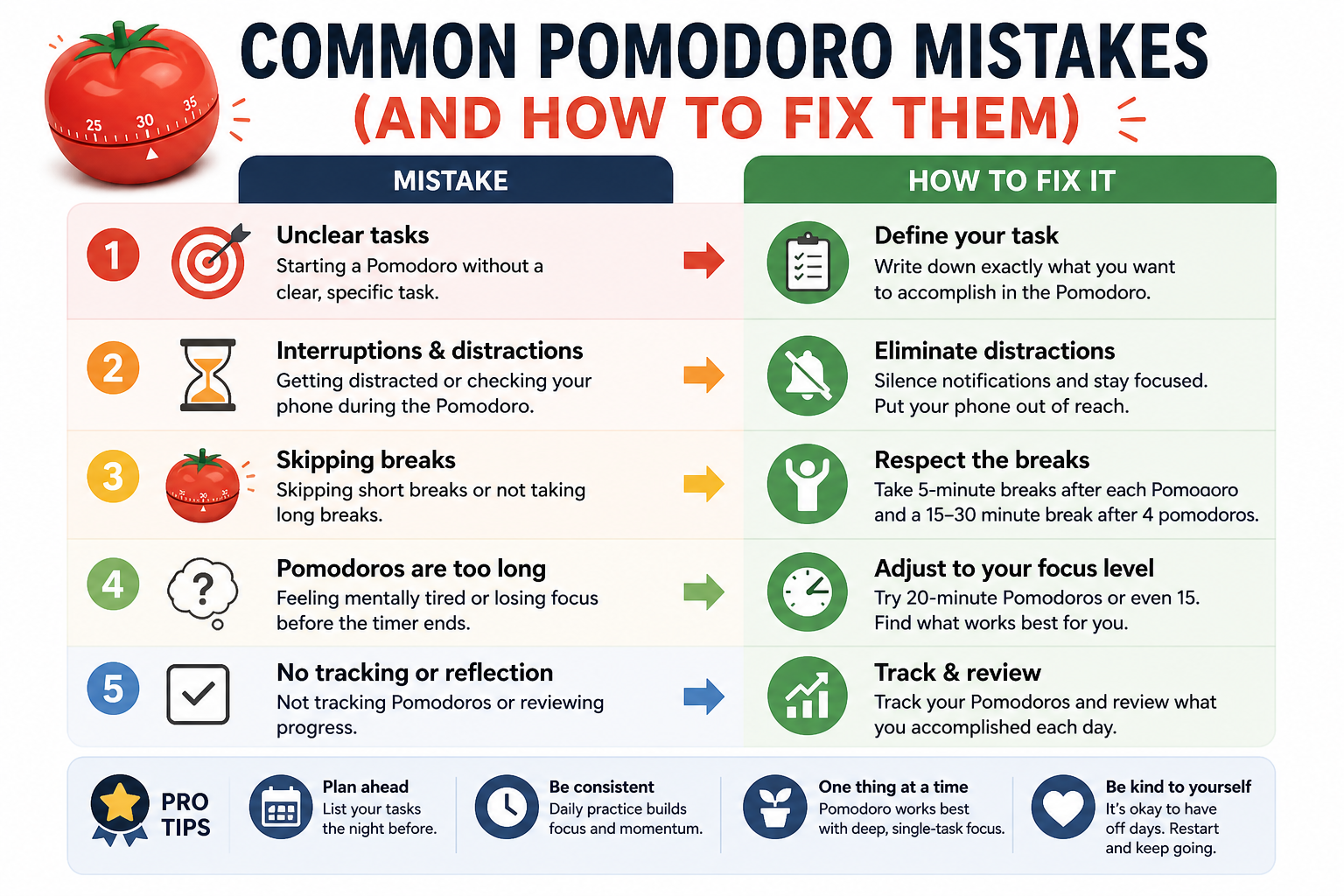
The mistakes below are the most common reasons Pomodoro fails for people who try it. Each one has a specific fix.
Section 02
Mistake 1: Skipping or Shortening Your Breaks
This is the single most common and most damaging mistake. When you are in the middle of a task and the timer rings, the temptation to keep going — especially when you feel like you are making progress — is strong. Many people skip the break entirely, or stop working but stay at their desk staring at their screen.
Cirillo's design makes the break non-negotiable. In his documented method, a Pomodoro is defined as a 25-minute work session plus its break — the two are inseparable. Skipping the break does not mean you have completed a Pomodoro; it means you have abandoned the method's core recovery mechanism.
The research supports why this matters. A 2023 study published in the British Journal of Educational Psychology by Biwer and colleagues, comparing Pomodoro-style structured breaks to self-regulated breaks among students, found that taking predetermined, systematic breaks produced mood benefits and appeared to have efficiency benefits — similar task completion in less total time — compared to students who decided for themselves when to pause. The students who took no structured breaks reported higher fatigue, lower concentration, and lower motivation. Skipping breaks trades short-term momentum for accelerating burnout.
The fix is simple but requires discipline: when the timer rings, stop — even mid-sentence. Stand up. Step away from your screen. Treat the break as a required component of the session, not a reward for finishing.
- Cirillo defines one Pomodoro as the work session plus the break — skipping the break is not completing a Pomodoro
- The 2023 Biwer et al. study found structured breaks produced efficiency benefits over unregulated pauses
- If you finish early, use remaining time to review your work — do not skip to the next task
- Fix: stop at the timer ring, every time, even mid-thought — then step away from your screen
Section 03
Mistake 2: Spending Your Break on Social Media or Email
A break in name only is not a break. The most common version of this mistake is picking up your phone during a 5-minute break and scrolling social media, checking messages, or reading news. This feels like rest because you have stopped the task — but it is not rest for your brain.
Cirillo's documented guidance on breaks is explicit: 'Do not engage in anything that requires significant mental effort.' The purpose of the break is cognitive disconnection. Social media, email, and news all require continuous processing of new information — they replace one form of mental engagement with another. As Gloria Mark, Professor of Informatics at the University of California, Irvine, documented in her research on workplace interruptions, it takes an average of 23 minutes and 15 seconds to fully regain deep focus after switching attention. Opening a social feed during a 5-minute break does not rest your working memory — it gives it a new task to process before you have even returned to the original one.
The fix for this mistake is addressed in detail in our guide on what to do during Pomodoro breaks, but the core principle is contrast: your break activity should contrast with your work. If your work is screen-based and cognitively demanding, your break should be physical and screen-free. Stand up, walk to another room, drink water, look out a window. Five minutes of genuine disconnection is worth far more than five minutes of social scrolling.
- Cirillo's rule: do not begin anything requiring significant mental effort during the break
- Social media and email keep your cognitive load elevated — they are not rest
- Research by Gloria Mark (UC Irvine) shows it takes over 23 minutes to regain full focus after a task switch
- Fix: use breaks for physical movement, hydration, and screen-free rest — not more screen time
Section 04
Mistake 3: Starting the Timer Without Deciding What You Will Work On
A very common beginner mistake is starting the Pomodoro timer first and then figuring out what to do. This reverses the method's intended order. The result is that the first several minutes of every session are spent deciding, browsing, or orientating — and by the time you settle into actual work, a meaningful portion of the 25 minutes has already passed.
Cirillo's original design begins with a planning step before any timer is started. Users create an 'Activity Inventory' listing all tasks, then compile a 'To Do Today' sheet selecting and prioritizing what they will tackle that day. The official pomodorotechnique.com website describes the full method as including 'daily planning, interruption management, and effort estimation' — not just the timer. The timer is, as Cirillo's site states, 'only the starting point.'
In practice, you do not need to use Cirillo's paper sheets to get the benefit. But you do need to know exactly what you are working on before you start the clock. 'Write report' is too vague. 'Draft the introduction section of the Q2 report' is a task. 'Study for the exam' is too vague. 'Work through Chapter 4 practice problems' is a task. Specific, scoped tasks allow your full 25 minutes to be productive from the first minute.
- Cirillo's method starts with planning — the timer comes after the task is chosen and scoped
- Vague tasks waste the first minutes of every session on orientation rather than work
- The official technique includes an Activity Inventory and a To Do Today sheet before any session begins
- Fix: before you start the timer, write down exactly what you will work on — specific enough that you can begin immediately when the timer starts
Section 05
Mistake 4: Abandoning the Session Every Time Something Comes Up
Interruptions are a normal part of any workday. The mistake is not getting interrupted — it is treating every interruption as a reason to fully abandon the session and start over. When this becomes a habit, practitioners end the day with zero completed Pomodoros and the impression that the method cannot work in a real environment.
Cirillo's original method has a specific protocol for handling interruptions, which he documented in his 2007 paper. The approach is summarized as: Inform, Negotiate, Schedule, Call Back. If someone interrupts you, inform them you are in a session. Negotiate a time to respond — even 'I'll come back to you in 10 minutes' is usually acceptable. Schedule the follow-up. Then call back after the break. For internal interruptions — thoughts that pop up during a session, things you suddenly remember you need to do — the method is to write them down immediately on a separate list and return to the task. The act of writing the thought down removes it from active working memory without requiring you to stop the session.
Cirillo was also clear that when a Pomodoro is definitively interrupted and cannot be recovered — for example, a genuine emergency — the session is void and must be restarted. The rule is not that you must complete every session perfectly; it is that a session is either complete or void. There is no such thing as a half-Pomodoro. This keeps the method's unit of measurement honest and prevents the habit of counting partial, distracted sessions as full ones.
- Cirillo's interruption protocol: Inform, Negotiate, Schedule, Call Back — most interruptions can wait 10-20 minutes
- Internal interruptions (thoughts, tasks that surface mid-session) should be written down and returned to later
- A definitively interrupted session is void and must be restarted — there is no partial Pomodoro
- Fix: use a scratch pad next to your timer to capture thoughts that surface mid-session — writing them down removes the urge to act on them immediately
Section 06
Mistake 5: Multitasking During the Work Interval
The entire value of a Pomodoro session comes from single-tasking — spending the full 25 minutes on one defined task. Switching between two or three tasks during a single session, or checking messages while ostensibly working on a report, makes the session feel productive while eliminating most of its actual benefit.
Research on multitasking consistently shows that task-switching carries a measurable cognitive cost. A study by the American Psychological Association found that switching between tasks can reduce productivity by as much as 40%, because the brain must reorient itself with each shift. The Pomodoro session is designed specifically to contain this — one timer, one task, for the full 25 minutes. When multitasking happens inside a session, the productivity loss that Pomodoro is designed to prevent reasserts itself.
Cirillo's documented rules for the session are unambiguous: 'Once a Pomodoro is set, it must ring. The Pomodoro is an indivisible unit of time and cannot be broken, especially not to check incoming emails, team chats, or text messages.' The same principle applies to switching tasks. If a different task becomes urgent during a session, write it down and either address it after the break or — if it is genuinely time-sensitive — void the current session, handle the urgent item, and start a fresh Pomodoro.
- One Pomodoro must equal one task — multitasking inside a session eliminates the method's core benefit
- The American Psychological Association documented up to 40% productivity loss from task-switching
- Cirillo's rule: the session cannot be broken for email, messages, or other tasks
- Fix: if a different task becomes urgent mid-session, write it down; void the session if genuinely necessary, then restart
Section 07
Mistake 6: Treating 25 Minutes as a Fixed Law Rather Than a Starting Point
Many people either quit Pomodoro because 25 minutes feels too short for their work, or struggle through it feeling artificially constrained. The 25-minute interval is Cirillo's default — it is not a universal prescription. Cirillo himself started at 10 minutes when he first developed the technique, as documented in the EBSCO Research Starters entry on the Pomodoro Technique, gradually increasing the interval as his ability to focus developed. The number 25 emerged from his own experience as a student, not from a controlled study of optimal attention spans.
The research on attention and focus supports flexibility. A 2025 paper by Benjamin Sharpe and Ian Tyndall published in Cognitive Science, cited in productivity research, noted that sustained attention on a single task typically declines after 10 to 25 minutes, but that the range is wide because decay speed varies with task type and individual differences. Monitoring a security feed degrades faster than drafting a report. A programmer loading a complex problem into working memory may need 15 minutes just to reach productive engagement — making a 25-minute session feel disruptively short. Creative writers, researchers, and developers frequently report that 45- or 50-minute intervals fit their work better.
The fix is to experiment. If 25 minutes consistently interrupts your flow before you have done meaningful work, try 35, 45, or 50 minutes. If 25 minutes feels too long to commit to — common for people new to structured work, or for tasks that feel aversive — try 15. The goal is a rhythm that creates enough urgency to start and enough runway to produce real work. The specific number matters less than the discipline of using a timer and taking a genuine break at the end.
- Cirillo started at 10 minutes and increased over time — 25 minutes is a default, not a law
- Research shows attention decay varies by task type and individual — there is no universally optimal interval
- Complex tasks with long cognitive ramp-up times (coding, writing, analysis) often work better at 40–50 minutes
- New users or people working on aversive tasks may do better starting at 15 minutes
- Fix: experiment with your interval length — find what creates enough urgency to start and enough runway to produce real work
Section 08
Mistake 7: Using the Timer But Never Tracking Your Sessions
Many people use Pomodoro purely as a focus timer — they start 25 minutes, take a break, repeat — but never record what they completed or how many sessions each task required. This loses one of the method's most useful long-term benefits: accurate task estimation.
Cirillo's design includes a tracking component as a core structural element, not an optional add-on. As described in the official pomodorotechnique.com documentation, the full method includes planning, tracking, recording, processing, and visualizing effort. Users record completed Pomodoros throughout the day, building a personal dataset that answers: how many sessions does writing a report actually take? How many does a code review take? Over time, this data eliminates planning fallacy — the near-universal tendency to underestimate how long tasks take — and allows practitioners to plan their days with much more accuracy.
In practice, tracking does not need to be complex. Cirillo's low-tech approach uses a simple sheet of paper with a tally mark for each completed Pomodoro and a note of which task it went to. After a few weeks, patterns emerge: most people discover that writing tasks take roughly twice as many sessions as they predicted, and that certain types of work are consistently draining at certain times of day. This data makes future planning more realistic and more sustainable.
- Cirillo's full method includes tracking sessions per task — not just using the timer
- Tracking builds a personal dataset that eliminates planning fallacy over time
- Most people systematically underestimate how many sessions a task requires — tracking reveals the accurate number
- Fix: after each session, make one tally mark for the task you worked on; review the totals at the end of the day
Section 09
Mistake 8: Using Pomodoro for Tasks That Do Not Benefit from It
Pomodoro works well for tasks that can be broken into focused, discrete work units: studying, writing, reviewing, coding features, answering a defined set of emails. It works less well — and can feel actively obstructive — for tasks that are inherently open-ended, collaborative, or flow-dependent.
Cirillo himself noted in his documented method that 'the Pomodoro Technique shouldn't be used for activities you do in your free time. In fact, use of the Pomodoro would make these activities scheduled and goal-oriented. That's no longer free time.' The same logic extends to certain work activities. A brainstorming session benefits from open-ended, pressure-free exploration — adding a countdown timer can create anxiety rather than focus. A collaborative meeting has its own cadence determined by other people. Highly creative flow states, as discussed in our guide to Pomodoro vs. time blocking, can be disrupted by the forced stop of a timer.
Recognizing which tasks are a good fit for Pomodoro — and routing other work differently — is part of using the method well rather than expecting it to solve every productivity challenge.
- Pomodoro works best for: writing, studying, reviewing, coding, defined task lists
- Pomodoro works poorly for: open-ended brainstorming, meetings, tasks requiring extended uninterrupted flow
- Cirillo himself said the technique should not be applied to free-time activities — structure defeats the purpose
- Fix: use Pomodoro for work you can define and scope; use other approaches (time blocking, free work) for collaborative or open-ended tasks
FAQ
Common questions
Why is the Pomodoro Technique not working for me?
The most common reasons are: skipping or shortening breaks, using social media or email during breaks, starting the timer before deciding what to work on, or abandoning sessions every time an interruption occurs. Each of these mistakes removes a structural component of the method. Work through the list above to identify which error applies to your situation — most people are making one or two specific mistakes rather than being fundamentally incompatible with the method.
Is it okay to keep working when the Pomodoro timer rings?
No — and this is one of the most common mistakes. Cirillo's rule is that 'if a Pomodoro begins, it has to ring,' which means you must also stop when it rings. The break is a structural part of the session, not optional. A 2023 British Journal of Educational Psychology study by Biwer et al. found that students who took predetermined systematic breaks completed similar work in less time with better mood outcomes than those who regulated their own breaks. The moment you start skipping breaks, you are no longer using the Pomodoro Technique — you are just working with a timer.
What should I do if I finish a task before the 25 minutes are up?
Cirillo's documented guidance is to use the remaining time for overlearning — reviewing what you just completed, making small improvements, or reflecting on what you learned — until the timer rings. Do not start a new task and do not check your phone. If the remaining time is genuinely minimal (one or two minutes), use it to prepare for the next session: glance at your task list and note what comes next.
Should I restart the timer if I get interrupted during a session?
It depends on the interruption. For brief, manageable interruptions, Cirillo's method is: inform the person you are in a session, negotiate a time to respond after your break, note the item on your list, and continue. For unavoidable interruptions that force you to fully stop your work, the session is void and must be restarted from zero when you are free. There is no partial Pomodoro — a session either completes or it does not count.
Is 25 minutes too short for deep work?
For many tasks, yes. A 2025 paper by Sharpe and Tyndall published in Cognitive Science noted that attention decay varies significantly by task type and individual — there is no universally optimal interval. Developers, writers, and researchers who need 10 to 15 minutes just to load a complex problem into working memory frequently find 25 minutes too constraining. The fix is to experiment: try 40 or 50 minutes for tasks requiring deep focus, and see whether your session quality improves. Cirillo himself started at 10 minutes and worked up to 25 — the number is a default, not a requirement.
Can I check my phone during a Pomodoro break?
It is not recommended. Gloria Mark's research at UC Irvine found that it takes over 23 minutes to fully regain deep focus after switching attention. Checking social media or messages during a 5-minute break gives your working memory a new task to process before the break even ends. For breaks to serve their function, they need to provide genuine cognitive disconnection — physical movement, hydration, and screen-free activities are more restorative than switching to a different screen.
Does it matter what I use as a timer?
It matters more than most people think, but not for technical reasons. Cirillo advocates for a physical, analog timer because the act of manually winding it creates a physical commitment to the session. Using your phone as a timer introduces the risk of seeing notifications every time you glance at it to check the time — which is one of the most reliable ways to break focus mid-session. A dedicated browser timer, a physical timer, or a Pomodoro app with your phone face-down all avoid this problem.